

Vermin control and foxing are vital, yet highly challenging aspects of UK countryside management. Left unchecked, fox populations can devastate agricultural livestock, ground-nesting birds, and local biodiversity, while invasive rat populations contaminate feed and spread disease.
Because the cunning red fox is predominantly nocturnal, using the cover of darkness to hunt and traverse the landscape, traditional daylight optics are entirely useless. To safely, ethically, and effectively manage these predators, modern hunters have fully embraced advanced optoelectronics: Thermal Imaging and Digital Night Vision (NV).
While both technologies allow you to "see in the dark", they operate on entirely different physics, and each presents unique advantages alongside distinct safety considerations in the field. In this guide, we will break down the technical specifications (such as NETD and IR wavelengths), explain how harsh UK weather impacts your sensors, and explore how to build the ultimate night-time rig using premium firearms from Edgar Brothers supported brands like Bergara and Schmeisser.
The Technical Breakdown: How the Optics Work
To choose the right optic for your foxing setup, you must look past the product jargon and understand the fundamental specifications of light amplification versus heat detection.
Digital Night Vision (NV)
Digital night vision relies on amplifying existing ambient light (moonlight, starlight) or detecting the specific wavelength of an infrared (IR) illuminator.
- The Sensor: The objective lens gathers available photons and hits a highly sensitive digital CMOS sensor. The processor amplifies this signal and projects the image onto an internal micro-display, typically in high-contrast black and white.
- IR Illuminators (850nm vs 940nm): Because digital NV struggles in pitch-black conditions, you must attach an IR torch.
- 850nm: This wavelength provides a massive detection range (often 300+ yards) but produces a faint red glow at the emitter source. Educated, "lamp-shy" foxes can sometimes spot this glow.
- 940nm: This is entirely covert and invisible to animals, making it perfect for close-range ratting or highly pressured foxes. However, the visible range is significantly shorter at around 100 to 150 yards.
Thermal Imaging
Thermal imaging devices do not see light at all; instead, they detect infrared radiation (heat). Every object above absolute zero emits a thermal signature.
- NETD (Noise Equivalent Temperature Difference): This is the most critical metric of a thermal scope, measured in millikelvins (mK). A lower number is better. A sub-25mK sensor can detect minute temperature differences (like the heat of a footprint on cold grass), whereas an older 50mK sensor will produce a blocky, less detailed image.
- Pixel Pitch (12µm vs 17µm): A smaller micron (µm) pitch, such as 12µm, allows for a sharper image at higher base magnifications. This provides a crisper image when you digitally zoom in on a target.
Field Performance: Detection, Identification & Backstops
The golden rule of nocturnal pest control is to detect with thermal and identify with night vision.
|
Field Capability |
Thermal Imaging |
Digital Night Vision |
|
Detection Speed |
Unmatched. A glowing heat source instantly stands out against cold surroundings. |
Moderate. Requires sweeping an IR beam, which can cause eye fatigue over time. |
|
Identification |
Poor. A glowing blob could be a fox, a badger, or a small deer. |
Excellent. Photo-realistic rendering allows you to see fur patterns, eyes, and specific features. |
|
Backstop Safety |
Dangerous. Thermal cannot "see" cold twigs or thin wire fences, masking ricochet hazards. |
Safe. The IR beam illuminates branches, fences, and the terrain directly behind the target. |
Safety Warning: Because thermal scopes cannot clearly resolve cold objects like thin branches or wire fences in the foreground, you risk a bullet deflecting off an unseen obstacle. Furthermore, assessing a safe earthen backstop behind the target is incredibly difficult with thermal. Digital NV provides a much clearer understanding of the terrain geometry.
Operating in Harsh UK Weather
The unpredictable British weather dictates how your optoelectronics perform.
Fog, Mist, and Rain
- Thermal: Moisture is the enemy of thermal imaging. Heavy rain "washes" the environment, cooling everything down to the exact same ambient temperature and drastically reducing thermal contrast. Dense fog physically blocks infrared radiation, resulting in a flat, washed-out grey image.
- Night Vision: Fog and mist act like a mirror for your IR torch. The intense infrared beam reflects directly off suspended water droplets back into the NV sensor, creating an impenetrable wall of white glare (similar to using main beam headlights in a fog).
Sub-Zero Battery Management
Both Thermal and Digital NV units are power-hungry, active electronic devices. In sub-zero winter temperatures, the chemical reactions inside standard lithium-ion batteries slow down significantly. This results in sluggish processor performance, frozen screen refresh rates, and drastically reduced battery life.
- Best Practice: Always carry spare, fully charged battery packs inside your internal jacket pocket (close to your body heat) to swap out during the night.
Zeroing a Thermal Scope: Tricks of the Trade
Zeroing a standard daytime scope is straightforward, but zeroing a thermal scope presents a unique challenge, primarily because paper targets do not emit heat. To zero a thermal optic effectively, you must create a contrast point on your target board.
- The Hand-Warmer Trick: Pin a small, activated disposable hand warmer to the centre of your target at 100 yards. This will glow brilliantly in your thermal display.
- The Foil Tape Trick: In daylight, place a square of reflective aluminium foil tape on the target, angled slightly upward. The foil will reflect the cold temperature of the sky, creating a stark "cold spot" (black square) on the target board for you to aim at.
Building the Ultimate Night-Time Foxing Rig
Setting up a purpose-built night rig requires a highly accurate, flat-shooting rifle platform capable of supporting heavy, bulky electronics.
The Bolt-Action Powerhouse: Bergara B14 HMR (.22-250 Rem)
For the dedicated foxer engaging targets across open fields, the Bergara B14 HMR (Hunting Match Rifle) chambered in the blistering .22-250 Remington is an exceptional choice.
- The incredibly flat trajectory of the .22-250 provides a massive margin for error when estimating distance in the dark.
- The HMR's internal aluminium mini-chassis provides immense rigidity for heavy thermal scopes, while the adjustable cheek piece ensures perfect eye alignment with optics that typically sit much higher than traditional daylight scopes.
The Modern Straight-Pull: Schmeisser SP15 Ultramatch (.223 Rem)
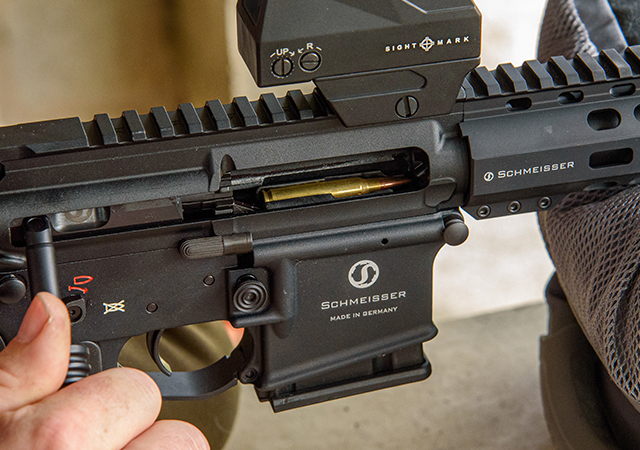
For rapid target acquisition and modularity, the Schmeisser SP15 Ultramatch straight-pull AR-15 chambered in .223 Remington is a stellar nocturnal tool.
- The continuous top Picatinny rail provides infinite mounting space for long digital NV scopes and external IR illuminators, ensuring you achieve perfect eye relief.
- The heavy match barrel prevents heat mirage from blurring your thermal optic during protracted culling sessions.
Close-Range Vermin Control: EBA Agincourt PCP
For ratting inside barns, feed sheds, or clearing feral pigeons from outbuildings, a centrefire rifle is far too loud and highly dangerous. The EBA Agincourt Synthetic Pre-Charged Pneumatic (PCP) air rifle (available in .177 or .22) provides a discreet, whisper-quiet platform. It is perfect for mounting lightweight digital NV scopes and 940nm covert IR torches for close-range surgical precision around livestock.
Protecting Your Investment: The Magpul DAKA® Hard Case
Thermal and NV scopes are fragile, highly expensive pieces of microelectronics. Throwing a rifle equipped with a £3,000 thermal optic loosely into the back of a 4x4 or quad bike is a recipe for a lost zero and a shattered lens.
The Magpul DAKA® LR53 Hard Case is the ultimate storage solution. Completely weather-sealed against the damp UK climate, it replaces traditional pluck foam with the revolutionary DAKA Grid system. This allows you to securely block out the massive, irregular shape of a night vision optic, ensuring your rifle remains perfectly zeroed despite the rough and tumble of farm tracks.
Conclusion
Mastering night-time pest control requires a deep understanding of advanced optoelectronics and environmental physics. While Thermal Imaging provides unparalleled detection capabilities and cuts through pitch-black darkness, Digital Night Vision remains the gold standard for positive target identification and critical backstop safety.
By combining these technologies with a flat-shooting, ergonomic rifle from Bergara or Schmeisser, employing robust mounting solutions, and protecting your setup in a premium Magpul DAKA case, you ensure safe, ethical, and highly effective predator management under the cover of darkness.

FAQs
Yes. Unlike traditional image intensifier tube (analogue) night vision, which can be permanently destroyed by bright sunlight hitting the phosphor screen, digital night vision and thermal imaging sensors are completely immune to daylight. You can safely use a thermal scope to zero your rifle on a sunny afternoon.
Thermal sensors rely on temperature differences (contrast) to generate an image. Heavy rain physically cools down the surrounding environment (trees, rocks, grass) so that everything is roughly the exact same temperature. Without contrast, the software can only display a flat, uniform grey image.
Is it legal to use night vision to shoot foxes in the UK?
Yes. Under UK law, it is completely legal to use digital night vision, thermal imaging, and artificial illumination to shoot foxes, provided you have the landowner's explicit permission and hold the correct conditions on your Firearm Certificate (FAC).