

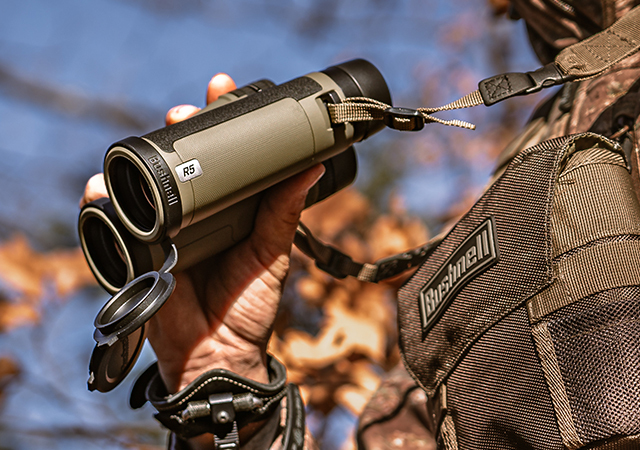
High-quality optics are the cornerstone of any successful hunter’s kit. Whether you are navigating dense lowland forestry for elusive Roe deer or glassing expansive Scottish glens for Red stags, a significant portion of your time in the field will be spent with binoculars in hand.
Your binoculars are not just for spotting quarry; they are essential for assessing the age, health, and suitability of the animal, identifying potential hazards, and crucially, confirming a safe backstop before an ethical shot is taken.
While there is no single "perfect" set of binoculars for every scenario, understanding the science of optics and how it applies to British wildlife will help you select the ultimate tool for your specific environment. In this guide, we explore magnification, low-light performance, optical terminology, and highlight superlative offerings from leading brands available through Edgar Brothers.
Tailoring Your Optics to UK Deer Species
The UK is home to six species of wild deer, and the environment in which you hunt them heavily dictates your optimal optical setup.
|
Deer Species |
Typical Habitat |
Stalking Distance |
Recommended Optic |
|
Muntjac & Chinese Water Deer |
Dense woodland, thick undergrowth, field margins. |
Close (50m - 100m) |
8x42 (Prioritises wide field of view and rapid target acquisition). |
|
Roe Deer |
Mixed woodland, arable borders, hedgerows. |
Close to Medium (50m - 150m) |
8x42 or 10x42 (Depends on the density of the specific permission). |
|
Fallow & Sika Deer |
Parkland, mature coniferous woodland, open clearings. |
Medium to Long (100m - 200m+) |
10x42 (Greater magnification required for picking out herd dynamics). |
|
Red Deer |
Expansive Scottish Highlands, open moorland. |
Long to Extreme (150m - 300m+) |
10x42 or 12x50 (Essential for identifying royal stags and glassing vast distances). |
Understanding Magnification: 8x42 vs 10x42 Explained
The most common debate amongst British deer stalkers is whether to choose an 8x42 or 10x42 binocular.
8x42: The Woodland Stalker's Choice
For woodland stalking, an 8x magnification, like the Bushnell R5 binoculars is widely considered the gold standard.
- Wider Field of View (FOV): An 8x optic allows you to scan dense forestry much faster, making it easier to pick up the flick of an ear or the horizontal line of a deer's back at close quarters.
- Image Stability: Lower magnification means the natural tremors in your hands are less pronounced, providing a steadier image when glassing off-hand without the support of shooting sticks.
- Depth of Field: 8x binoculars typically offer a greater depth of field, meaning you spend less time constantly adjusting the focus wheel as deer move through the trees.
10x42: The Open Hill Specialist
If you are stalking on open moorland, expansive arable fields, or the Scottish Highlands, the 10x42 configuration, like the Bushnell Powerview 2 comes into its own.
- Finer Target Detail: The extra magnification allows you to accurately count the tines on a stag's antlers or identify a specific beast within a large herd at extended ranges.
- The Trade-Off: The FOV is narrower, and the image is slightly more prone to shake. To maximise the potential of a 10x or 12x binocular, you will frequently need to brace your elbows or glass from a seated, supported position.
Low Light Stalking: Objective Lenses, Exit Pupil, and Twilight Factor
Successful deer stalks usually take place at first light or dusk, when light levels are critically low. To successfully hunt in these "golden hours," you must understand how your binoculars gather and transmit light.
The Objective Lens & Exit Pupil
The diameter of the objective lens (e.g., the "42" in 8x42) dictates how much raw light the binocular can gather. The "exit pupil" is the actual shaft of light that reaches your eye, calculated by dividing the objective lens by the magnification:
- 8x42 Binocular: 42 ÷ 8 = 5.25mm exit pupil
- 10x42 Binocular: 42 ÷ 10 = 4.2mm exit pupil
In low light, a healthy human pupil dilates to around 5mm to 7mm. Therefore, the 8x42 provides a shaft of light that perfectly matches a dilated pupil, making the image appear brighter when it matters most. While larger 50mm or 56mm objective lenses draw in even more light, they become exponentially heavier and bulkier for the nomadic stalker.
The Twilight Factor
The Twilight Factor is a mathematical formula used to compare how effectively different binoculars resolve detail in low light. It is calculated by multiplying the magnification by the objective lens diameter and finding the square root.
While an 8x42 has a better exit pupil, a 10x42 actually has a slightly higher Twilight Factor, meaning that if the glass quality is identical, the 10x42 might allow you to resolve a finer detail (like antler tines) in the gloom, even if the overall image appears slightly dimmer.
Decoding Optical Terminology: ED Glass and Lens Coatings
To truly evaluate a premium hunting binocular, you must look beyond the numbers and understand the quality of the glass itself.
- ED (Extra-Low Dispersion) Glass: Standard glass splits light into different colour wavelengths, which can cause "chromatic aberration" (a purple or green halo around high-contrast objects, like dark antlers against a bright sky). ED glass concentrates these wavelengths perfectly, resulting in a razor-sharp, colour-true image.
- Fully Multi-Coated (FMC) Lenses: Bare glass reflects light away. FMC means that every air-to-glass surface inside the binocular has multiple layers of anti-reflective chemical coatings. This is what separates a cheap binocular from a premium one, ensuring up to 90%+ light transmission.
- Phase-Corrected Roof Prisms: Modern, sleek hunting binoculars use "Roof Prisms." However, roof prisms naturally cause light waves to shift out of phase, reducing contrast. Premium optics apply phase-correction coatings to the prisms to restore ultimate sharpness and contrast.
Key Features to Look for in Robust Hunting Binoculars
The British weather is notoriously unforgiving. Your chosen optics must be built to endure the rigours of the field. Ensure your binoculars feature:
- IPX7 Waterproofing & Fog Proofing: The internal chassis must be O-ring sealed and purged with nitrogen or argon gas to prevent internal fogging when moving between cold air and a warm vehicle.
- Rubber Armouring: Essential for shock resistance against accidental drops and for silent handling in the woods (metal clinking against a rifle stock will instantly spook deer).
- Tripod Compatibility: If you are using high-magnification optics (10x or 12x), ensure the chassis has a threaded port for a tripod adapter.
Pro Tip: Ditch the standard neck strap. Invest in a dedicated bino harness (bino caddy). This keeps the optics tight to your chest, preventing them from swinging and gathering debris when you are crawling into a firing position.
Top Bushnell Binocular Recommendations for British Stalkers
When it comes to enduring the unpredictable British weather while delivering razor-sharp optical performance, Bushnell offers a suite of superlative optics for the discerning UK stalker.
1. The Premium Stalker: Bushnell Engage EDX Binoculars
If you demand the absolute pinnacle of visual clarity for picking out a deer's coat in low-light environments, the Bushnell Engage series is a masterclass in optical engineering.
- ED Prime Glass: Bushnell's highest-quality Extra-Low Dispersion glass guarantees amazing colour resolution and contrast, entirely eliminating chromatic aberration.
- EXO Barrier Protection: The lenses are coated with Bushnell's proprietary EXO Barrier. This molecularly bonds to the glass, actively repelling water, oil, dust, and debris, ensuring your lenses stay crystal clear during a torrential highland downpour.
- Configurations: Available in classic 10x42 for general stalking, as well as 10x50 and 12x50 variants for glassing massive, open environments.
2. The Rugged All-Rounder: Bushnell R5 Binoculars
The R5 line-up sits directly in the sweet spot of high performance and rugged utility, making it an exceptional daily workhorse for UK stalkers.
- HD Optical System & BaK-4 Prisms: Fully multi-coated lenses combined with dielectric prism coatings ensure light transmission remains incredibly high as dusk approaches.
- Tactical Durability: Built with a shockproof, IPX7 waterproof-sealed chassis and nitrogen purging, they are impervious to extreme temperature shifts and internal fogging. They also feature a Ranger Green colourway and dual rubber overmould to silence impacts against your rifle stock.
- Included Bonus: The R5 binocular comes straight out of the box with the Vault Lite chest harness, keeping your optics tight to your chest when crawling or navigating thick brush. Available in both 8x42 and 10x42.
3. The Budget-Friendly Workhorse: Bushnell R3 8x42
For those entering the sport of deer stalking without wanting to compromise on foundational optical quality, the Bushnell R3 series offers exceptional value. Providing a bright, clear image, comfortable ergonomics, and rugged construction, the R3 8x42 gives you the wide field of view necessary to spot movement in dense British woodland without breaking the bank.
Conclusion
There is no single "best" set of binoculars for UK deer stalking, but there is certainly a perfect pair tailored to your specific environment and quarry.
If you stalk dense woodland for Roe and Muntjac, a robust 8x42 with ED glass will serve you flawlessly. If you hunt the open hill for Red stags, lean towards a 10x42 or 12x50. For those who want to streamline their gear and leverage modern ballistics, investing in a laser-rangefinding binocular like the Hawke Frontier LRF is a tactical game-changer. Whichever you choose, invest in the best glass your budget allows. Your eyes, and your success rate, will thank you for it.
FAQs
For dense woodland, 8x magnification is widely considered optimal. It provides a wider field of view for spotting movement through trees, and the image is much steadier when glassing off-hand compared to a 10x magnification.
While not strictly necessary, rangefinder binoculars are highly advantageous. They combine two essential pieces of equipment into one, allowing you to instantly confirm the distance to your quarry for an ethical shot, calculate ballistic drop, or accurately gauge the distance to a safe backstop.
The first number (8x) refers to the magnification power; the object will appear 8 times closer than it would with the naked eye. The second number (42) is the diameter of the objective (front) lens in millimetres. A 42mm lens offers an excellent balance of light-gathering capability and physical weight.