

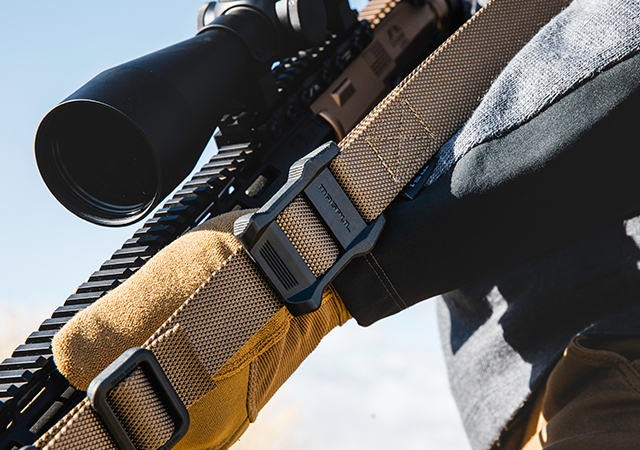
While high-magnification telescopic sights and massive objective lenses dominate the world of Extreme Long Range (ELR) and Precision Rifle Series (PRS) shooting, not every discipline requires you to read mirage at 1,000 yards.
For fast-paced, closer-range disciplines, such as Civilian Service Rifle (CSR), practical rifle shooting, and dynamic recreational target shooting, the emphasis shifts entirely. In these arenas, speed, efficiency, and rapid target acquisition take precedence over printing microscopic groups from a static prone position.
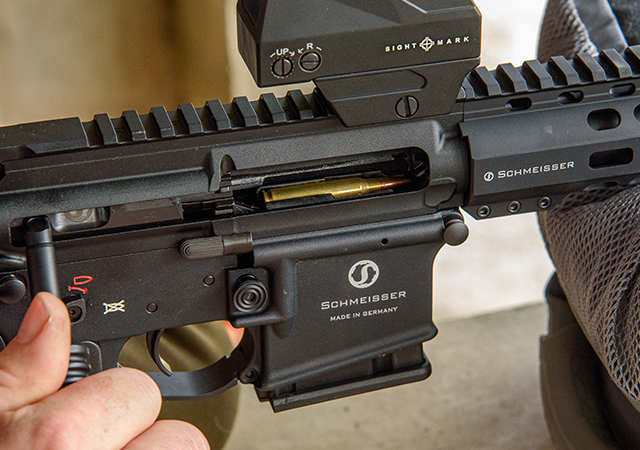
The firearms used in these disciplines reflect this high-speed focus. Rather than heavy, bespoke F-Class bolt actions, competitors typically favour straight-pull AR-15 platforms or authentic service rifles. A superlative example of this is the Schmeisser straight-pull rifle range. Highly customisable and featuring full-length Picatinny rails, these modern sporting rifles are built to accommodate a wide variety of sighting systems.
If you are setting up a rifle for practical shooting, you will ultimately face one major decision: Should you mount a Red Dot Sight or a Low Power Variable Optic (LPVO)? Here is our comprehensive guide to helping you choose the right sighting system for your discipline.
Red Dot Sights vs LPVOs: Understanding the Technology
Before diving into the pros and cons, it is vital to understand how these two dominant optical systems function.
The Red Dot Sight (Reflex Sight)
A red dot sight is a type of reflex sight designed for blistering-fast target engagements. Using an LED to project an illuminated dot onto a coated glass lens, they provide an uncluttered, simplistic sight picture that is incredibly effective for close-quarters encounters.
Red dots rarely provide any native magnification. By completely replacing traditional iron sights, they offer a vastly more user-friendly aiming solution. The size of the dot is measured in MoA (Minute of Angle), a 2 MoA dot is excellent for rifles as it covers less of the target at 100 yards, whereas a larger 6 MoA dot is often preferred for rapid pistol or practical shotgun shooting.
The LPVO (Low Power Variable Optic)
An LPVO is a traditional telescopic sight engineered with a smaller zoom range; typically 1-4x, 1-6x, 1-8x, or even 1-10x.
At its lowest 1x setting, it functions similarly to a red dot sight, allowing you to shoot with both eyes open for maximum situational awareness. However, with a quick throw of the magnification lever, you can zoom in to accurately engage targets at several hundred yards. LPVOs are standard issue for modern Designated Marksman Rifles (DMRs) and are the undisputed king of multi-gun and practical rifle competitions where target distances vary wildly from stage to stage.
Deep Dive: Pros & Cons of a Red Dot Sight
If absolute speed at short distances is your primary goal, the red dot sight is difficult to beat.
The Advantages:
- Infinite Eye Relief & Parallax Free: The dot remains fixed on the target irrespective of your head's position behind the glass. You don't need a perfect cheek weld to make an accurate shot.
- Maximum Situational Awareness: Shooting with both eyes open affords a massive, unobstructed field of view.
- Reduced Eye Strain: You do not have to force your eye to focus on a front iron sight post while blurring the target; you simply focus on the target and superimpose the dot.
- Ultra-Lightweight: Red dots weigh a fraction of an LPVO, keeping your rifle nimble and reducing fatigue during protracted courses of fire.
The Disadvantages:
- Lack of Magnification: Makes precise aiming, target identification, and spotting bullet splash at longer distances incredibly difficult.
- Astigmatism Issues: For shooters with an astigmatism, the illuminated dot may appear smeared, starburst, or distorted.
- Battery Dependency: Unlike an etched reticle in a scope, if the battery dies, you lose your aiming point entirely (unless you run backup iron sights).
Pro Tip: If you want the speed of a red dot but occasional magnification for 200-yard shots, consider pairing your red dot with a flip-to-side magnifier. This modular setup offers great versatility, though it adds weight and bulk.
Why Choose an LPVO for Practical Rifle Competitions?
For disciplines like CSR or multi-gun competitions where you shoot from various barricades and unsupported positions at varying ranges, the LPVO is arguably the most versatile optic available today.
While notably heavier than a red dot, an LPVO bridges the gap between speed and precision. The enhanced magnification allows you to clearly identify targets, read wind indicators, and use reticle subtensions to correct for bullet drop. Furthermore, because LPVOs use physically etched glass reticles, you still have a perfectly usable black aiming point even if your battery fails.
FFP vs SFP in LPVOs
When selecting an LPVO, you must choose between a First Focal Plane (FFP) or Second Focal Plane (SFP) reticle:
- Second Focal Plane (SFP): The reticle stays the same size regardless of magnification. This provides a large, highly visible aiming point at 1x, making it very fast. However, ballistic holdovers are only mathematically accurate at the maximum magnification setting.
- First Focal Plane (FFP): The reticle scales with magnification. Holdovers are accurate at every zoom level, making it superior for engaging mid-range targets on the clock without having to max out the zoom ring.
Top Optic Recommendations for Practical Rifle
Whether you are building a premium CSR rig or an entry-level straight-pull AR, Edgar Brothers offers exceptional optics tailored to the task.
1. The Premium FFP Choice: Zero Compromise Optic ZC210
The ZC210 from Edgar Brothers' supported brand Zero Compromise Optic (ZCO) is a masterclass in short-to-medium range optics. Featuring a 2-10x magnification range, this FFP scope delivers superlative edge-to-edge clarity and rugged durability.
It boasts an impressive 46 MRAD of elevation adjustment and comes with three distinct reticles tailored to practical and tactical shooting:
- DMR Reticle: Developed with the Austrian Special Forces, featuring a bracketed box for leading moving targets and Christmas-tree subtensions for rapid holdovers.
- Predator Reticle: Optimised for dynamic hunting and speed, featuring a bullet drop compensator (BDC) calibrated for standard 5.56 and 7.62 out to 600m.
- HTR Reticle: A brilliant hybrid for sport shooting. The large outer bars create an 18-inch circle at 200 yards for rapid range estimation, while retaining a fine centre dot that remains visible at low magnification.
2. The Budget-Friendly Contender: Bushnell R5 1-6x24mm
If you are looking to enter the world of practical rifle shooting without breaking the bank, Bushnell offers a superb entry point. The R5 1-6x24mm is a compact, SFP optic featuring 1/4 MoA adjustments and a generous 120 MoA of internal travel.
Its illuminated DD2-QA reticle features a precise 1 MoA centre dot surrounded by brackets, making it incredibly fast to pick up on the clock while still offering 22 MoA of calculated drop on the vertical axis for longer engagements.
Proper Mounting: Height Over Bore and Cantilever Mounts
When fitting an LPVO or red dot to a straight-pull AR-15 or similar modern sporting rifle, traditional scope rings often sit too low, preventing a proper cheek weld.
You must utilise a cantilever scope mount. A cantilever mount pushes the optic forward over the handguard, allowing you to achieve the correct eye relief without bridging the optic between the receiver and the rail (which degrades accuracy). Ensure your mount provides the correct "height over bore" (typically 1.54" to 1.93") to keep your head upright and comfortable during rapid transitions.
Speed vs. Magnification: The Final Verdict
As with all shooting equipment, everything is a trade-off.
If you are exclusively shooting at close-range targets with a pistol-calibre carbine, the raw agility, weight savings, infinite eye relief, and visual simplicity of a red dot sight make it the superlative option.
However, if your shooting scenario requires engaging targets across multiple distances (from 10 yards out to 500 yards), the LPVO is the clear winner. The versatility to run the optic on 1x for close-quarters speed, and instantly dial up to 6x or 10x for precision, covers far more ground. Given the choice for a general-purpose practical rifle, the LPVO provides a distinct competitive advantage.

FAQs
While possible with a flip-to-side magnifier, red dot sights are not designed for long-range precision. They lack the native magnification and fine reticle subtensions necessary to accurately compensate for bullet drop and wind drift at distance.
For rifles, a 2 MoA dot is generally considered the best all-rounder. It is small enough to allow for precise aiming at 100-200 yards without obscuring the target, but bright enough to be picked up quickly during rapid close-range engagements.
In an FFP scope, the reticle changes size as you adjust the magnification. This means that the ballistic holdovers and measurement hash marks on your reticle are mathematically accurate at every zoom level, which is a massive advantage in timed practical competitions.