

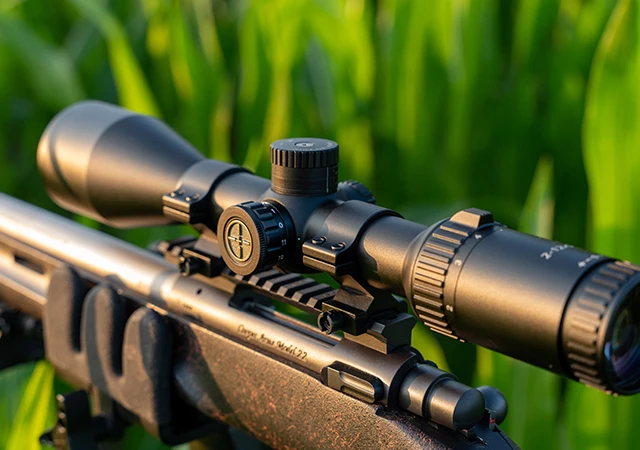
Telescopic sights are commonplace on bolt-action rifle platforms used for UK deer stalking, pest control, and target shooting. The sheer breadth of optics tailored for these different disciplines is staggering. A rifle is ultimately a tool designed to perform a specific function, and you must mount the exact right optical tool for the job.
Shooting is not a cheap sport, and premium telescopic sights can be eye-wateringly expensive. This high barrier to entry can sometimes give precision shooting a highly exclusive reputation. Fortunately, recent years have seen a massive leap in manufacturing technology. Many telescopic sights across a wide range of price points now offer excellent quality and high-end features that were once entirely exclusive to elite brands.
Whether you are seeking a reliable optic for highland stalking or a superlative tactical scope for Extreme Long Range (ELR) competitions, understanding what actually makes glass "good" will help you maximise your budget. In this comprehensive guide, we will explore the science of Extra Low Dispersion (ED) glass, the importance of lens coatings, mechanical tracking, and the real-world value of premium optics featuring Edgar Brothers supported brands Zero Compromise Optic (ZCO) and Bushnell.
The Physics of Light: What Makes "Good Glass" Good?
Good glass in a rifle scope provides a crisp, bright image with a broad field of view and zero colour distortion. The image should look exactly like perfect human colour vision, only magnified. Achieving this requires incredibly complex optical engineering to combat a phenomenon known as chromatic aberration.
Understanding Chromatic Aberration and Refractive Index
When natural white light enters a standard glass objective lens, it bends (refracts). Because different colours of light have different wavelengths, they bend at slightly different angles. If the optical prescription does not perfectly align these wavelengths back to the exact same focal point, the image will suffer from chromatic aberration. This is often referred to as colour fringing.
Glass that lacks corrective properties will display a purplish or yellowish halo around dark objects. This distortion obscures fine details and aggressively fatigues the shooter's eye, especially at higher magnifications or in fading light.
ED Glass and Schott Glass Excellence
To solve this optical flaw, manufacturers use Extra Low Dispersion (ED) or High Density (HD) glass. ED glass contains specific chemical properties that harmonise the different wavelengths of light. This forces them to meet at the exact same focal point to produce a pristine, true-to-colour image.
- The High-Value Contender: The Bushnell Match Pro ED is a prime example of a brand bringing specialist ED glass to the mainstream market. It offers shooters a sharp, bright image that vastly outperforms its price bracket, making it ideal for club-level Precision Rifle Series (PRS) matches.
- The Zero Compromise Standard: High Transmission (HT) lenses, such as German Schott glass, are the absolute benchmark of optical engineering. Premium scopes from Zero Compromise Optic (ZCO) feature flawless German Schott ED glass. By pairing this superlative clarity with massive internal elevation travel and tactile tactical turrets, ZCO has cemented itself as a dominant force in elite PRS and ELR competitions globally.
Refining and Protecting the Image: Lens Coatings
Exceptional bare glass is only half of the optical equation. Premium telescopic sights feature multiple layers of chemical lens coatings to enhance light transmission, reduce glare, and combat the unpredictable British weather.
Without anti-reflective coatings, a significant percentage of light would bounce off the objective lens and be lost to the atmosphere, resulting in a dark, unusable image at dusk. Premium scopes are "fully multi-coated", meaning every air-to-glass surface inside the scope tube is treated to ensure light transmission efficiencies that frequently exceed 90 percent.
Furthermore, manufacturers apply hydrophobic (water-repellent) and anti-abrasion coatings to the exterior lenses to protect the delicate glass from physical damage in the field.
Bushnell utilises their proprietary EXO Barrier coating on their scope lenses. This chemical coating bonds with the glass on a molecular level. It causes water droplets to bead tightly and roll off rather than pooling and distorting the image. It also repels grease (such as fingerprints) and prevents dust from adhering to the surface. This means less physical force is required to clean the lens, which drastically reduces the chance of accidental micro-scratches.
A word of caution regarding optics care. You should only clean lenses using dedicated air puffers, fine microfibre cloths, and specialist lens cleaning solutions that will not attack the protective coatings. Never use your shirt sleeve.
Focal Planes and Mechanical Precision
Glass quality is meaningless if the internal mechanics fail. A premium scope represents a marriage between optical clarity and rugged engineering.
First Focal Plane (FFP) vs Second Focal Plane (SFP)
- First Focal Plane: In an FFP scope, the reticle grows and shrinks as you adjust the magnification. This means the mil-radian or MOA hash marks are always accurate regardless of your zoom level. This is absolutely mandatory for PRS competitions where you must use the reticle to hold for wind or elevation quickly.
- Second Focal Plane: In an SFP scope, the reticle remains the exact same size at all magnifications. The hash marks are only accurate at one specific magnification setting (usually maximum zoom). This is traditionally preferred by deer stalkers who want a bold, visible crosshair at low magnification in dark woodland environments.
Mechanical Tracking and Return to Zero
When engaging targets at extreme ranges, you must dial your elevation turret to compensate for bullet drop. Premium optics like those from ZCO feature immaculately machined erector tubes and turret internals. This guarantees that when you dial 10 Mils of elevation, the reticle moves exactly 10 Mils. Furthermore, it guarantees that the scope will perfectly "return to zero" when you dial back down, ensuring your rifle remains perfectly zeroed for your next outing.
Twilight Factor vs. Exit Pupil: Decoding Low-Light Metrics
Historically, hunters relied on a mathematical formula called the Twilight Factor to determine how well a scope would perform at dusk. The formula is the square root of the magnification multiplied by the objective lens diameter. According to this old logic, the larger the Twilight Factor, the better the scope performs in the dark.
However, the Twilight Factor is a fundamentally outdated metric because it completely ignores glass purity and lens coatings. A vintage optic with poor coatings and a massive objective lens will have a high Twilight Factor, yet it will be vastly outperformed by a modern, fully multi-coated scope with a smaller lens.
Today, shooters should evaluate low-light performance by looking at the Exit Pupil. The exit pupil is the literal circle of light that leaves the rear eyepiece and enters your eye. You calculate it by dividing the objective lens diameter by the magnification setting. For example, a 56mm objective lens set at 8x magnification produces a 7mm exit pupil. Because the human pupil can only dilate to approximately 7mm in pitch-black conditions, this scope provides the absolute maximum amount of light your eye can physically process. This makes it the perfect mathematical setup for low-light woodland stalking.
Application in the Field: The Real-World Value of Premium Glass
Investing in a premium optic affords the user the capacity to see a highly detailed image across a broad range of challenging environmental conditions.
UK Deer Stalking and Hunting
In a hunting scenario, enhanced clarity and colour fidelity enable the user to identify camouflaged quarry against cluttered backgrounds. Roe deer seamlessly blend into their woodland environment; they often only give their position away when they twitch an ear. The brightness afforded by premium ED glass tips the odds in your favour. It allows you to positively identify your target safely during the critical first and last hours of daylight.
Long-Range Precision Shooting
In target shooting disciplines, glass quality dictates whether you can actually see what your bullet is doing at 1,000 yards. Premium optics allow both the shooter and the spotter to clearly identify bullet trace (the visible vapour trail created by the bullet displacing air) and the splash of a miss in the dirt. This directly informs the precise turret corrections needed for a rapid follow-up shot.
Furthermore, high-end scopes allow shooters to read mirage (heat boil) with total clarity. By observing how the mirage ripples across the target, an experienced marksman can deduce the exact wind direction and intensity downrange.
To answer the fundamental question of whether you truly need the best glass, you should smartly invest in the very best optics that you can reasonably afford. While having top-tier equipment will never mask poor marksmanship fundamentals, a superlative optic guarantees logical ease of use, exceptional mechanical longevity, and the optical clarity required to hit targets when lesser scopes fail. Good rifles come and go, but premium glass is an investment that will serve you for a lifetime.

FAQs
ED stands for Extra Low Dispersion. It is a specialised type of glass engineered to prevent the dispersion of light wavelengths as they pass through the lens. This eliminates chromatic aberration (colour fringing), resulting in a much sharper and highly colour-accurate image.
Not necessarily. While a larger objective lens (like a 56mm) can physically gather more light than a smaller lens (like a 42mm), the actual brightness you see depends heavily on the quality of the glass and the anti-reflective lens coatings. A high-quality 42mm scope will often appear brighter and clearer than a cheap 56mm scope.
How do I clean my rifle scope lenses safely?
Never use your shirt or a standard tissue, as these contain abrasive fibres that will permanently scratch the lens coatings. First, use a blower bulb or a soft optical brush to remove loose dust and grit. Then, apply a dedicated optical cleaning fluid to a clean microfibre lens cloth and gently wipe the lens in a circular motion from the centre outwards.