

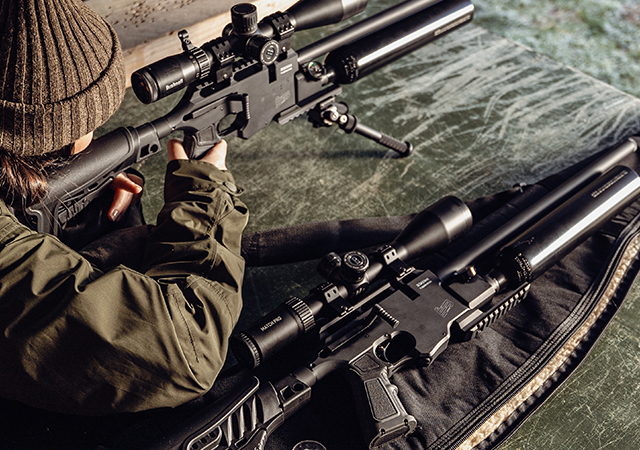
The Precision Rifle Series (PRS) is rapidly becoming one of the most popular and highly competitive target shooting disciplines in the UK, contested in both full-bore and small-bore (.22 LR) formats.
Unlike the static, prone disciplines of Extreme Long Range (ELR) or F-Class, PRS is a highly dynamic, high-octane sport. Competitors engage steel gongs at varying distances under strict time limits, shooting from barricades, rooftops, tank traps, and other improvised rests. This invokes a distinctly tactical, sniper-style flavour that tests not just the inherent accuracy of your rifle, but your physical athleticism, mental agility, and gear management.
To compete at a high level, you need a profound understanding of your rifle's ergonomics, your ammunition's external ballistics, and how environmental conditions impact bullet flight. Furthermore, you must be intimately familiar with your telescopic sight to dial rapid elevation corrections and adjust parallax on the clock.
However, none of this matters if your gear fails or you leave mission-critical equipment at home. In this blog, we will break down exactly what you need in your range bag to dominate your next PRS match.
Choosing the Right Hard Case for Heavy PRS Rigs
PRS rifles feature heavy contour barrels, massive optics, and solid chassis systems designed to absorb recoil. Consequently, you must pack a wide range of supporting equipment. You require a robust, tank-like hard case to safely store your rifle and organise your kit, allowing you to focus purely on executing a flawless stage.
Magpul offers a phenomenal range of rugged storage solutions under the DAKA® line. The DAKA hard case offerings are stout, virtually indestructible units built to withstand the rough and tumble of loading in and out of 4x4s, protecting your zero against physical shocks and drops.
Crucially, these cases utilise Magpul’s DAKA Grid Organiser system—a revolutionary alternative to pluck foam that allows you to instantly reconfigure the internal blocks to securely cradle your specific rifle setup.
The Magpul DAKA® LR53 Hard Case
The Magpul DAKA LR53 is the largest of the hard case offerings and is the logical choice for a heavy PRS rig. The case is incredibly strong, fully weather-sealed, and features heavy-duty wheels for easy mobility. When you are hauling a 20lb rifle and accompanying accessories across the uneven ground of a Welsh PRS stage or the National Shooting Centre at Bisley, those wheels are a competitive game-changer.
Mastering Positional Support: Barricade and Rear Bags
You will rarely shoot from a perfectly flat, supported prone position in a PRS match. You will be forced to balance your rifle on fence posts, tyre stacks, and wobbly wooden barricades. To achieve acceptable accuracy from these unstable platforms, shooting bags are absolutely critical.
- The Heavy Barricade Bag: Often referred to as a "game-changer" style bag, this is a heavy, sand-filled bag draped over a barricade. You drive the forend of your rifle deep into the bag, which conforms to both the obstacle and the rifle chassis, creating a remarkably stable, locked-in shooting platform.
- The Rear Squeeze Bag: Essential for the few prone stages you will encounter. Placed under the buttstock, you squeeze the bag with your non-firing hand to make microscopic elevation adjustments without disrupting your firing position.
Ballistics Data and D.O.P.E. Management
In PRS, you do not have time to guess holdovers or manually calculate drops on a smartphone app while the clock is ticking. You must arrive at the firing line with pre-calculated, verified data.
- D.O.P.E. (Data On Previous Engagements): You must chronograph your exact match ammunition to determine your true muzzle velocity. Input this data, along with your bullet's Ballistic Coefficient (BC), into a ballistic solver to generate drop charts.
- Atmospheric Tools: Air density changes constantly. A dedicated weather meter (such as a Kestrel) is essential for recording real-time temperature, barometric pressure, and humidity to update your D.O.P.E. cards immediately before a stage.
- Armboards & Data Cards: Write your specific elevation dials and wind holds for each target on a physical dope card. Mount this card to an armband or a dedicated rifle-mounted data board so you can reference it instantly without breaking your cheek weld.
The Essential Tools and Maintenance Kit to Pack
In competitive shooting, Murphy’s Law reigns supreme. Screws shoot loose, extractors fail, and optics get knocked against barricades. Packing a dedicated maintenance kit is highly advised. If your rifle goes down on stage one and you lack the tools to rectify it, your match fee and travel expenses are entirely wasted.
To avoid losing tiny Torx bits and vital spares in the bottom of a massive rucksack, a dedicated organisation pouch is essential. The Magpul DAKA Utility Organiser (Large) is the perfect weather-resistant, zip-up solution. It easily houses your preset torque wrenches, Allen keys, lens pens, spare batteries, and emergency gun oil, keeping them instantly accessible.
Organising Your Ammunition and Magazines
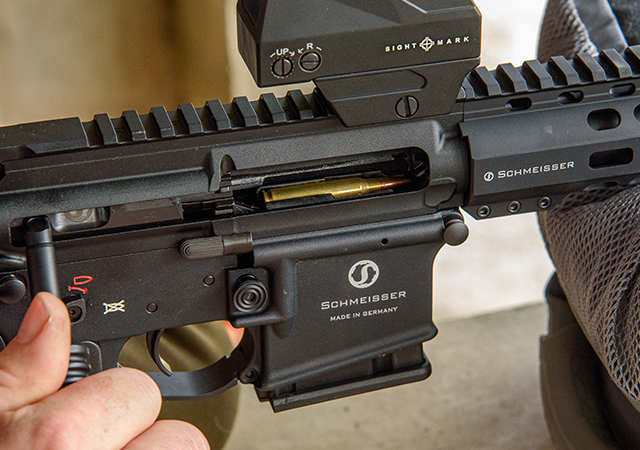
Keeping your ammunition neatly organised and protected from dirt and moisture is paramount. In the high-speed tactical environment of PRS, you will be feeding your rifle from box-type magazines, most likely AICS (Accuracy International Chassis System) pattern magazines paired with a tactical chassis like the Magpul Pro 700.
- Magazines: You should carry multiple reliable magazines. The Magpul PMAG 10 7.62 AC - AICS Short Action is the gold standard for feeding 7.62x51mm, 6.5 Creedmoor, and other short-action bottleneck cartridges smoothly under pressure.
- Ammo Storage: While you can use DAKA spacers to dedicate a section of your hard case for ammunition, it is often more prudent to carry your heavy match ammo in a dedicated soft bag, such as the Bergara Shooting Range Bag. This keeps your primary rifle case lighter and allows you to carry your ammunition, data cards, and hydration packs from stage to stage with ease.
The Magpul DAKA® Ecosystem: Waterproof, Durable Organisation
The Magpul DAKA range extends far beyond hard cases, offering a complete ecosystem of storage solutions that are robust, weather-resistant, and logically designed to work in tandem.
For the serious PRS competitor battling the unpredictable British weather, keeping your data cards and electronics dry is non-negotiable.
|
DAKA Product |
Primary PRS Application |
|
DAKA Grid Organiser |
Replaces standard foam in hard cases; infinitely customisable for different rifles. |
|
DAKA Waterproof Pouches |
Ideal for storing printed drop charts, match booklets, and FAC documents safely. |
|
DAKA Suppressor Pouches |
Heat-resistant storage for transporting hot sound moderators off the range. |
|
DAKA Window Pouch |
Perfect for storing and instantly identifying different sets of hex keys or spare screws. |
|
DAKA Can 2.0 |
Crush-proof cylindrical storage for protective eyewear, earplugs, or delicate electronics. |
Building a Pre-Stage Routine
Gear alone will not win a match. When it is your turn to shoot, you usually only have 90 to 120 seconds to engage multiple targets. Establishing a strict pre-stage routine is essential for managing cognitive load.
1.Visualise the Stage:
Before the timer starts, visually identify every target in sequence. Note the distances and any specific wind indicators (mirage, moving grass) near the target line.
2.Check Your Gear State:
Ensure your magnification is dialled back to a wider field of view (e.g., 10x-15x) to easily find the first target. Check that your parallax is set to the middle distance of the stage, and ensure your bipod legs are deployed to the correct height.
3.Verify Your D.O.P.E.:
Confirm your elevation dials are written clearly on your armboard. Dial your scope to the exact elevation required for Target 1 so you are ready to fire immediately upon taking your position.
4.Manage Your Magazines:
Ensure your primary magazine is fully loaded and seated correctly, and that your backup magazine is easily accessible on your belt in case of a malfunction.
The Ultimate PRS Match Checklist
Prior planning prevents poor performance. Use this comprehensive checklist to ensure you hit the firing line fully prepared.
1. Administration & Paperwork
- Valid Firearms Certificate (FAC) or Shotgun Certificate where applicable.
- Shooter Certification Card (SCC) – mandatory for MoD ranges and Bisley.
- Competition entry confirmation and stage briefings.
- Accommodation details and travel itinerary.
2. Hardware & Kit
- Competition Rifle (zeroed, cleaned, and mechanically checked).
- Primary Precision Optic (clean lenses, fresh illumination battery).
- Primary Tactical Bipod and necessary barricade stops.
- Heavy barricade bag and rear squeeze bag.
- Primary match ammunition (pack 20% extra for re-shoots or zero checks).
- Multiple reliable AICS magazines (e.g., Magpul PMAGs).
- Atmospheric weather meter (e.g., Kestrel).
- Accurate, laminated D.O.P.E charts for your specific load.
- Laser Rangefinder and/or high-magnification binoculars.
- Rifle maintenance tool kit, cleaning rod, and chamber flag (Empty Chamber Indicator).
- Appropriate tactical clothing, kneepads, waterproofs, food, and plenty of water.
3. Software (Mindset & Preparation)
- Are you fully rested, hydrated, and physically prepared for the demands of the day?
- Have you dry-fired and practiced transitioning between improvised positions?
- Are you completely up to speed with the specific competition rules and safety mandates?
Conclusion
Preparing for a PRS match demands the same methodical precision as the shooting itself. Taking the time to carefully plan your loadout, calculating flawless ballistic data, and investing in premium storage solutions, like the Magpul DAKA system and Bergara range bags, will drastically reduce your stress levels on match day.
When your gear is protected, organised, and instantly accessible, you free up your mental bandwidth to focus purely on reading the wind and executing a perfect trigger press. The crucible of competition is where shooters forge their skills; pack smart, shoot straight, and enjoy the challenge.

FAQs
Most competitors use heavy-barrelled, bolt-action rifles set into rigid aluminium chassis systems (like the Magpul Pro 700). The most popular calibres are low-recoiling, high-ballistic-coefficient rounds such as 6.5 Creedmoor, 6mm Creedmoor, or .308 Winchester (for Tactical class).
What is the difference between F-Class and PRS?
F-Class is shot purely from the prone position at known distances using highly specialised rests, focusing on extreme microscopic precision. PRS is a dynamic, timed sport where competitors move between improvised barricades, shooting at multiple unknown or varied distances, testing both speed and practical accuracy.
While scopes with 25x or 35x magnification are common, most PRS shooters actually engage targets on 12x to 15x magnification. This provides a wider field of view, making it much easier to transition between multiple targets and spot your own bullet splash on the steel. A First Focal Plane (FFP) scope is essential so your reticle holdovers remain accurate at any magnification.