

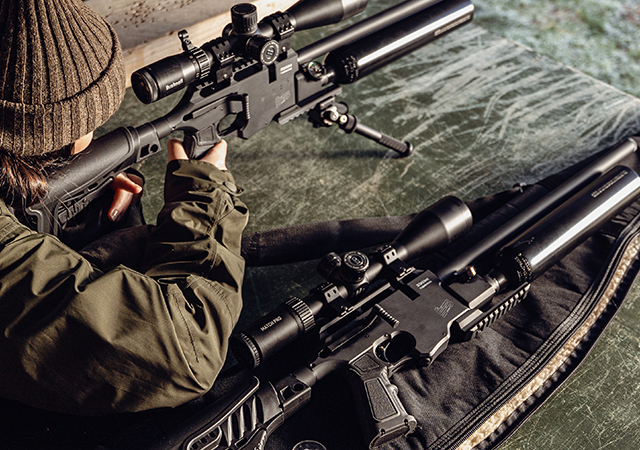
A fundamental adage within the tactical shooting community is that “a sling is to a rifle what a holster is to a pistol.”
Far more than just a convenient carrying strap for the walk from your vehicle to the firing point, a high-quality sling is an essential piece of marksmanship equipment. Whether you are navigating the dynamic, high-stress stages of a Civilian Service Rifle (CSR) match, shooting Mini-Rifle, or carrying a heavy precision rig on a prolonged winter hunt, a properly configured sling is vital. It allows you to safely retain your firearm, free up your hands for secondary tasks (such as reloading or barrier manipulation), and lock your body into a rock-solid shooting position.
While slings come in various historical and modern configurations, the debate for modern sporting rifles and tactical chassis systems almost exclusively comes down to two options: the single-point and the two-point sling.
In this guide, we break down the applications, advantages, optimal mounting locations, and marksmanship techniques for both systems to help you completely optimise your practical rifle setup.
The Evolution of the Rifle Sling in Practical Shooting
Historically, rifle slings were constructed from heavy leather and used primarily as static marksmanship aids (such as the traditional "Loop Sling" technique used by military snipers and target shooters). While exceptionally stable, these older systems were slow to adjust and cumbersome to wear.
The birth of modern practical shooting disciplines required a revolution in sling design. Shooters needed lightweight, synthetic webbing that wouldn't absorb water, combined with rapid-adjust cams that allowed a rifle to transition from a tight, hands-free carry to a loose, combat-ready firing stance in a fraction of a second. Today, selecting the correct sling layout dictates how efficiently you can manoeuvre your firearm under the ticking clock of a competition timer.
Single-Point Slings: Speed and CQB Agility
As the name suggests, a single-point sling connects to the firearm at only one point—typically at the rear of the receiver or the buffer tube end-plate. The sling itself forms a large, continuous loop that is worn diagonally across the shooter's torso.
The Advantages of a Single-Point Setup
A single-point sling maximises absolute agility and nimbleness. Its primary advantage is freedom of movement. Because the front of the rifle is completely untethered, you can instantly transition the rifle from your dominant to your non-dominant shoulder. This is a critical skill for engaging targets from behind cover (such as a VTAC barricade) without unnecessarily exposing your body.
Furthermore, a rifle equipped with a single-point sling can be brought to the "ready" position incredibly quickly. It is highly favoured for close-quarters law enforcement applications, Practical Shotgun, or short-range, fast-paced Mini-Rifle stages where time is the ultimate deciding factor.
The Disadvantages: The Pendulum Effect
The major drawback of the single-point sling is the "pendulum effect." Because the heavy muzzle is left entirely unsupported, if you drop the rifle to transition to a sidearm (such as a Long Barrelled Pistol), or simply need both hands to climb an obstacle, the rifle will swing violently against your knees or groin. It requires constant hand-control when moving, making it a poor choice for long-range hiking, deer stalking, or navigating rough terrain.
Two-Point Slings: Stability and Field Versatility
The two-point sling is the traditional standard issued to militaries worldwide and is the most ubiquitous setup found on civilian ranges. It features two attachment points: one near the muzzle or forend, and one at the rear of the buttstock.
The Advantages of a Two-Point Setup
A two-point sling excels in both comfort and absolute stability. By tethering both ends of the rifle, it keeps the firearm flat against your chest or back when hands-free, completely eliminating the frustrating pendulum swing of the single-point. You can easily hike for miles with the muzzle pointed safely up or down without the rifle banging against your legs.
More importantly for the practical shooter, the modern two-point sling is the ultimate marksmanship aid. Premium tactical slings feature rapid-adjust sliders or pull-tabs. With a quick pull of this tab, you can instantly cinch the rifle tight into your body to create a rock-solid, supported shooting position from kneeling or standing, vastly outperforming a single-point for mid-to-long-range engagements.
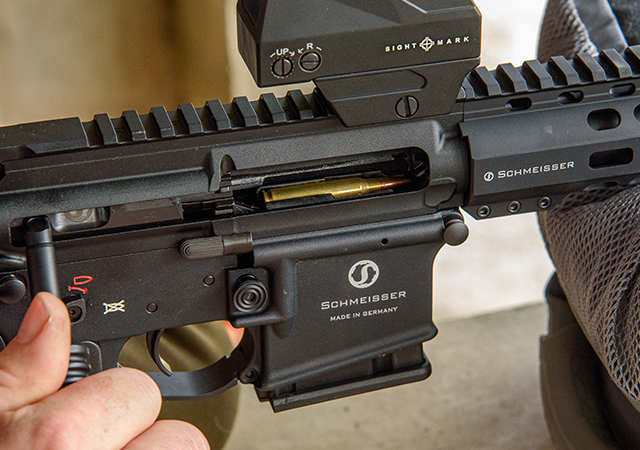
The Best of Both Worlds: The Magpul MS3® GEN2 Sling
What if you want the agility of a single-point for close-range barricade work, but the stability and retention of a two-point for moving between stages?
Magpul, a brand proudly supported by Edgar Brothers, solved this dilemma with the highly versatile Magpul MS3® GEN2 Sling.
Constructed from heavy-duty, 1.25-inch snag-free nylon webbing, the MS3 features bespoke Paraclip™ shackles. This hardware allows the shooter to instantly detach the front of the sling from the rifle's forend and clip it directly into the rear sling hardware. In under three seconds, you can convert your rifle from a stable two-point patrol configuration into a highly dynamic single-point setup. It also features a low-profile quick-adjust slider, allowing you to add or remove sling tension with a single hand.
(Note: If your rifle is heavily outfitted with QD flush cups, Magpul also offers the MS4 Sling, which functions identically to the MS3 but utilises push-button QD hardware instead of Paraclips).
Where to Mount Your Rifle Sling
Having the right sling is only half the battle; where you attach it to your rifle chassis fundamentally alters how the gun balances and hangs.
|
Attachment Point |
Setup Characteristics |
Best Application |
|
Front: Muzzle End |
Provides maximum control over the muzzle but can impede access to bipods or cause the sling to snag on barricades. |
Traditional hunting; long-range target shooting. |
|
Front: Near Receiver |
Keeps the sling clear of barricades and forward grips. Allows for faster target transitions. |
Practical Rifle; CSR; CQB environments. |
|
Rear: End of Buttstock |
Carries the rifle higher on the back. Can sometimes choke the shooter during rapid transitions. |
General field carry; heavy precision rifles. |
|
Rear: Receiver End plate |
Rifle hangs naturally flat against the chest. Allows for incredibly fast shoulder transitions. |
Modern sporting rifles; tactical chassis. |
Sling Mounting Hardware: QD Swivels vs Traditional Studs
How you attach your sling to your rifle dictates how quickly you can remove it in an emergency.
Traditional Sling Swivel Studs
Found on almost all classic hunting and bolt-action rifles, the swivel stud is a simple metal post with a drilled hole affixed to the underside of the stock. A classic sling swivel uses a cross-pin to securely clamp through this hole.
- Pros: Time-tested, sleek, and exceptionally strong.
- Cons: Fiddly to attach or remove. Unclamping a tight swivel requires manual dexterity, which is incredibly frustrating when you have cold, wet hands on a winter range day.
QD (Quick Detach) Sling Mounts
The modern standard for tactical chassis and AR-15 style platforms. A QD attachment consists of a metal post fitted with spring-loaded ball bearings. You simply press the button on the top, push the mount into a flush-machined steel cup on your rifle chassis, and release the button to lock it in place.
- Pros: Push-button operation allows you to instantly detach the sling if it becomes dangerously entangled on a barricade. The sockets often feature anti-rotation mechanisms to prevent the sling strap from twisting.
- Cons: Requires a modern rifle chassis or the addition of an Magpul SGA Receiver Sling Mount to be installed on your forend.
Marksmanship Masterclass: The "Hasty Sling" Technique
A two-point sling is an active stabilisation tool. To maximise your accuracy from an unsupported standing or kneeling position, you should employ the "Hasty Sling" technique.
- Adjust Length: Ensure your two-point sling is loose enough to allow full movement, hanging just below your chest.
- Thread the Arm: Thrust your support arm (non-firing arm) through the sling loop, from the outside in.
- Wrap the Forearm: Bring your hand down and back up over the outside of the sling, wrapping the webbing tightly around your forearm, and firmly grasp the rifle's handguard.
- Create Tension: As you pull the rifle securely into your firing shoulder, the sling should bite into your tricep and forearm. This creates an isometric physical triangle between your shoulder, your support hand, and the sling.
- Execute the Shot: This tension drastically reduces the crosshair's figure-eight wobble, allowing for a highly precise shot even without a bipod or barricade.
Conclusion
A high-quality sling is a prudent, highly effective investment that transforms how you handle, carry, and shoot your firearm.
While the extreme agility of the single-point sling has its place in specialised, short-range scenarios, we generally advise the unmatched versatility, safety, and stability afforded by the modern two-point sling for practical rifle shooting in the UK. By choosing a convertible system like the Magpul MS3, ensuring you have the correct QD hardware mounted to your chassis, and mastering the hasty sling technique, you can tailor your setup on the fly to dominate any stage you encounter.
FAQs
Yes, two-point slings are excellent for Practical Shotgun disciplines. However, you must ensure the sling does not drape over the loading port or interfere with the pump action (if applicable). Mounting the front attachment slightly further back towards the receiver often solves this issue.
A QD (Quick Detach) flush cup is a recessed steel socket built into modern rifle stocks, chassis systems, and M-LOK rail adapters. It accepts push-button QD sling swivels, providing a highly secure, low-profile attachment point that allows the sling to be instantly removed with one hand.
Is a single-point sling good for hunting?
Generally, no. Because a single-point sling only attaches to the rear of the rifle, the heavy muzzle is left completely unsupported. If you are walking over rough terrain, navigating fences, or bending down, the rifle will swing violently like a pendulum. A two-point sling is vastly superior for securing a rifle across your back or chest while stalking.