

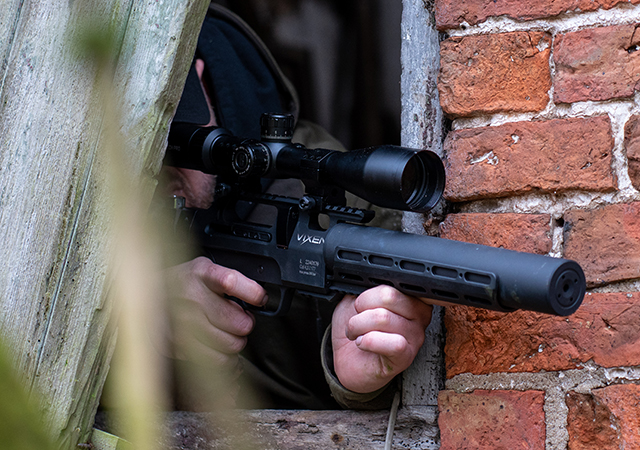
Sound moderators, such as the Svemko Genesis Pro frequently referred to as suppressors or silencers, have become a ubiquitous and highly essential accessory for the modern UK shooter. While Hollywood portrays them as completely silencing a firearm with a subtle "pew," the reality of ballistics dictates that a discharging firearm is never truly silent. However, when paired with subsonic ammunition, highly attenuating sound moderators drastically reduce the concussive muzzle report.
Beyond noise reduction, sound moderators dampen felt recoil and completely eliminate muzzle flash. The added weight at the end of the barrel can also vastly improve the balance and swing of a rifle system, particularly on compact or short-barrelled hunting rifles. In many UK deer stalking scenarios, the use of a moderator is actively encouraged; or even mandatory, to protect the hearing of the stalker, the guide, and working dogs.
However, shooting with a suppressor requires strict adherence to maintenance and safety protocols. From managing extreme heat and preventing catastrophic barrel corrosion to understanding the latest UK firearms legislation, this comprehensive guide explores how to safely transport, store, and clean your sound moderator.
2026 UK Law Update: Sound Moderators "Off Ticket"
Before discussing physical storage, UK shooters must understand the monumental legal changes regarding sound moderators.
For decades, moderators for Section 1 firearms were classed as actual firearms under the Firearms Act 1968. This meant applying for a variation, paying fees, and waiting weeks for a "slot" on your Firearm Certificate (FAC).
As of 29 June 2026, this requirement was completely scrapped. Under Section 44 of the Crime and Policing Act 2026, sound moderators and flash suppressors were removed from the legal definition of a firearm.
- What this means: You no longer need a variation on your certificate to buy, sell, or replace a moderator. You can purchase one online or in-store simply by presenting a valid FAC or Shotgun Certificate.
- Storage Law: Legally, an "off ticket" moderator no longer has to be locked in your primary gun cabinet. However, to prevent theft and protect a highly expensive accessory, we still strongly advise storing them securely alongside your other optics and shooting gear.
Why You Must NEVER Store Your Rifle with a Moderator Attached
If there is one cardinal rule of sound moderator ownership, it is this: never leave it attached to your rifle in the gun safe.
When you fire a rifle, the sound moderator acts as a high-pressure trap for hot, expanding gases. These gases are laden with unburnt powder, hygroscopic carbon, and highly corrosive ammonia. As the moderator cools down, condensation naturally forms inside the baffles.
If you place a rifle into a safe with the moderator still screwed onto the muzzle, this toxic, moisture-rich cocktail will slowly drip backward down the bore. This creates a perfect storm for galvanic corrosion. Because the moderator (often aluminium or titanium) and the barrel (steel) are dissimilar metals, the moisture acts as an electrolyte. Within a matter of days, this will aggressively attack the steel, rusting the crown and pitting the rifling of your barrel, permanently destroying the rifle's accuracy.
Always unscrew your sound moderator immediately after your shooting session concludes.
Thermal Mirage and the Dangers of Hot Transport
The gases produced inside a discharging firearm are exceptionally hot. Over a protracted course of fire on the range, or following a rapid cull, a sound moderator can easily reach temperatures capable of causing third-degree burns.
1. Thermal Mirage
As a moderator heats up, heat waves rise directly off the metal. When you look through your telescopic sight, this "thermal mirage" drastically distorts your target image, making precision shots nearly impossible.
- The Solution: Many shooters use a Kevlar or Nomex suppressor cover to trap this heat and eliminate mirage.
- The Catch: These covers trap heat so efficiently that if you leave them on after shooting, you will bake the internal components of the moderator. Always slide the cover off to allow the moderator to air-cool after a string of fire.
2. Transporting a Hot Moderator
Placing a blistering hot moderator directly into a soft gun slip or a foam-lined hard case will instantly melt the polymer padding. This permanently ruins the case and bonds melted plastic directly to your moderator's Cerakote finish. It also poses a genuine fire risk.
3. Preventing "Carbon-Lock"
If you wait until a moderator is stone-cold to remove it, the carbon buildup and thermal contraction can cause the unit to "carbon-lock" (seize) onto the barrel threads.
- Pro Tip: Apply a microscopic dab of high-temperature anti-seize grease or copper slip to your barrel threads before attaching the moderator. Remove the moderator while it is warm (using a heat-resistant glove or pouch), but not blistering hot.
Premium Hardware: The Svemko Genesis
If you are shooting protracted courses of fire where heat buildup is a major concern, the materials your moderator is constructed from matter immensely.
The Svemko Genesis is a superlative example of modern suppressor engineering. It features an outer tube constructed from Grade 5 Titanium, housing a core optimiser machined from Inconel. Inconel is a nickel-chromium-based superalloy typically reserved for aerospace engineering and jet engine turbine blades. It is designed to withstand extreme thermal shock and pressure, making the Genesis incredibly durable for high-volume shooting while remaining astonishingly lightweight.
Upgrading Your Kit: Storage Pouches and Thread Protectors
1. Dedicated Suppressor Pouches
Having a dedicated storage pouch for your sound suppressor is a prudent investment. It keeps dirty, carbon-fouled moderators separated from your clean gear and protects the unit from scratches during transit.
Magpul offers dedicated pouches as part of their renowned DAKA® line. The Magpul DAKA Suppressor Storage Pouch is constructed from tough, weather-resistant, and non-hygroscopic polymer-infused textiles. Note: Even heavy-duty pouches are not designed for red-hot suppressors; always allow the unit to cool before stowing it.
2. The Importance of Thread Protectors
When you remove your moderator, you expose the precisely machined male threads on your rifle's muzzle (e.g., 5/8x24 UNEF, M18x1). A simple knock against a door frame can ding these threads, leading to a misaligned moderator and a catastrophic baffle strike (where the bullet hits the inside of the moderator).
Always carry a thread protector, which is a small, knurled metal cap that screws over the exposed threads. This protects the muzzle from physical damage and the elements, allowing you to safely transport and store the firearm in a "naked" configuration.
A Guide to Cleaning Your Sound Moderator
Sound moderators require routine maintenance to ensure longevity and reliable attenuation. Carbon and copper fouling will eventually build up inside the baffles, adding unnecessary weight and reducing the internal volume (which diminishes sound reduction).
The Weight Test
How do you know when a sealed moderator needs cleaning? Weigh it when it is brand new and write the weight down. When the moderator gains 15 to 20 grams, it is time for a deep clean, as that weight is pure carbon buildup.
1.Mechanical Disassembly (If Applicable):
If your moderator is modular, disassemble the unit to expose the internal baffles. Use dedicated carbon-fouling solvents and nylon brushes to manually scrub the baffles. Inspect the internal structures for excessive wear or baffle strikes.
2.Ultrasonic Cleaning (Exercise Caution):
For sealed suppressors, an ultrasonic cleaner is highly effective. However, only use benign, non-caustic cleaning solutions. Harsh, ammonia-based chemicals or aggressive ultrasonic frequencies will pit aluminium baffles and instantly strip Cerakote or anodised finishes.
3.Flush and Dry:
Once the cleaning cycle is complete, thoroughly flush the moderator with clean water to remove all dislodged debris. Use an air compressor to blow out the internal baffles.
4.Lubricate and Reassemble:
Leave the moderator in a warm, dry environment (like an airing cupboard) until it is bone-dry. Spray a light water-dispersing oil inside to prevent rust. Lightly lubricate the O-rings and threads with anti-seize grease before reassembly to ensure they do not bind together.
Conclusion
Sound moderators are an invaluable accessory for UK shooters, making range days vastly more civilised and deer stalking significantly safer for your hearing. Furthermore, the 2026 legal deregulation has finally made acquiring them a painless process.
However, this tactical advantage requires a fastidious approach to safety and maintenance. By never storing your rifle with the moderator attached, allowing it to cool properly before transport, preventing carbon-lock, and utilising premium storage solutions like the Magpul DAKA pouches, you ensure your equipment remains in peak condition for seasons to come.

FAQs
Yes. As of 29 June 2026, sound moderators were removed from the legal definition of a firearm under the Crime and Policing Act 2026. You no longer need a variation on your Firearm Certificate (FAC) to purchase one. However, you still must hold a valid FAC or Shotgun Certificate to legally possess a moderator intended for a Section 1 firearm.
Yes. If you are actively hunting and moving between locations in your vehicle throughout the day, it is generally fine to leave it attached. However, the moment you are finished shooting for the day and the rifle is going back into the gun safe overnight, the moderator must be removed to prevent rapid corrosion.
How do I safely remove a stuck sound moderator (Carbon-Lock)?
If a moderator becomes "carbon-locked" to the barrel threads, do not force it with a wrench, as this can severely damage the barrel's crown. Apply a penetrating gun oil to the base of the threads and let it soak for several hours. In the future, apply a high-temperature anti-seize grease or copper slip to the barrel threads before attaching the moderator.