

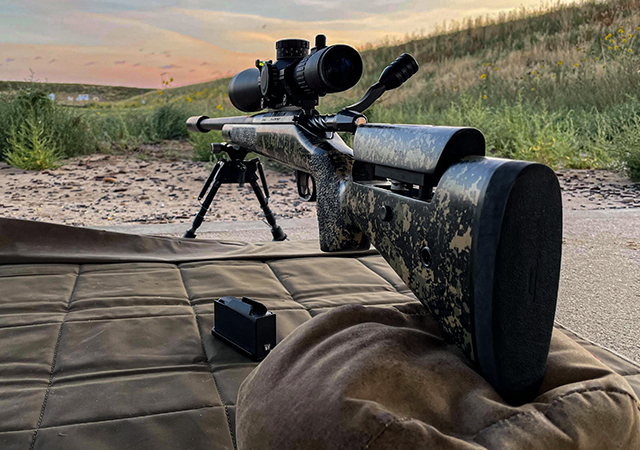
High-quality, incredibly precise ammunition is the absolute foundation of long-range shooting. Whether you are competing in a dynamic Precision Rifle Series (PRS) match, shooting F-Class at 1,000 yards, or taking an ethical shot on a highland deer stalk, your rifle is only as accurate as the cartridge you feed it.
For decades, the standard progression for precision shooters was to quickly abandon factory ammunition and invest heavily in reloading equipment. However, modern manufacturing techniques and CNC-machined tooling have narrowed the gap significantly. Today, shooters face a complex choice: rely on superlative, modern factory offerings, or invest the time, money, and extreme fastidiousness required to hand-load their own bespoke cartridges.
In this blog, we will explore the objective ballistics of both approaches, detail the essential equipment required to start reloading, and decode the critical variables of load development; featuring industry-leading brands like Hornady, Sellier & Bellot, and Hodgdon, all supported by Edgar Brothers.
The Golden Age of Factory-Loaded Ammunition
For the modern shooter, factory-loaded ammunition offers unparalleled convenience. Manufactured to strict SAAMI (Sporting Arms and Ammunition Manufacturers' Institute) or C.I.P. standards, this ammunition guarantees safe, reliable functionality across a vast spectrum of rifle chambers and climatic conditions.
While bulk "plinking" ammo varies in consistency, premium factory match ammunition has reached an era of unprecedented quality. The consistency of powder charges, brass neck tension, and bullet seating depths batch-to-batch is now tight enough to yield highly predictable, confidence-inspiring performance that can rival hand-loads out to 800 yards.
Top Tier Factory Offerings for Precision
- Hornady Match™ Ammunition: Hornady’s Match line is the gold standard for factory precision. Loaded with extraordinarily high-Ballistic Coefficient (BC) projectiles like the ELD® Match (Extremely Low Drag), BTHP Match™, and the revolutionary aluminium-tipped A-TIP® Match, these rounds excel in slicing through wind deflection at extreme distances.
- Sellier & Bellot Target (Match): A phenomenal choice for the competitive shooter, S&B's Match line utilises incredibly consistent Hollow Point Boat-Tail (HPBT) projectiles. They offer sound flight characteristics and exceptionally tight velocity spreads, making them ideal for protracted range sessions where consistency is paramount.
The Value of Training Ammunition
Consistency breeds accuracy. To shoot well at long range, you must practice your fundamental mechanics (breathing, trigger press, recoil management) extensively. Burning through premium ELD Match ammunition at 100 yards is a needless financial waste. Sellier & Bellot Training (FMJ) ammunition utilises Full Metal Jacket projectiles that are cheaper to mass-produce, offering the perfect, cost-effective solution for volume positional practice and barricade drills.
Hand-Loading: The Pursuit of Sub-MOA Precision
Hand-loading (reloading) is the process of custom-assembling live rounds using the four core components: a brass case, a primer, a smokeless powder charge, and a projectile.
Safety Warning: Hand-loading is a potentially dangerous activity. Poorly assembled rounds or excessive powder charges can cause catastrophic firearm failure, serious injury, or death. Always strictly follow published load data from powder manufacturers.
Why do long-range shooters bother reloading when Hornady Match ammo is so good? Complete ballistic control.
Factory ammunition is built to shoot well in every rifle. Hand-loaded ammunition is built to shoot perfectly in your rifle. By tuning the cartridge to the specific chamber dimensions and barrel harmonics of your firearm, you can drastically reduce your Extreme Spread (ES) and Standard Deviation (SD).
- Why this matters: At 1,000 yards, a variation of just 30 feet per second (fps) in muzzle velocity will cause your bullet to impact several inches higher or lower than your point of aim. Hand-loading allows you to achieve single-digit SDs, virtually eliminating vertical dispersion on the target.
|
Feature |
Factory-Loaded Ammunition |
Hand-Loaded Ammunition |
|
Convenience |
Instant readiness; simply buy and shoot. |
Highly time-consuming and labour-intensive. |
|
Accuracy Ceiling |
Excellent (Sub-MOA is common). |
Supreme (Can achieve 0.25 MOA with careful tuning). |
|
Initial Cost |
Zero equipment required; pay per box. |
High upfront cost for presses, dies, and measuring tools. |
|
Long-Term Cost |
Remains consistently high for premium calibres. |
Significant savings per round by reusing fired brass cases. |
|
Calibre Availability |
Subject to supply chain and mainstream popularity. |
Infinite. Allows you to shoot obscure or "wildcat" cartridges. |
Essential Reloading Equipment for Beginners
Reloading is an initially expensive endeavour that requires a dedicated, quiet, and highly organised workspace. For beginners, we strongly recommend completing an accredited reloading course or finding a mentor.
To safely and effectively assemble your own precision ammunition, you will need to invest in the following core equipment:
- The Press: The mechanical heart of the bench. The Hornady Lock-N-Load® Classic Press is a fantastic single-stage starting point, while the heavy-duty Lock-N-Load® Iron Press® offers supreme rigidity for resizing large magnum rifle cases.
- Dies: You require calibre-specific dies for resizing fired brass and accurately seating new bullets (e.g., Hornady Custom Grade Dies).
- Precision Measurement: Absolute accuracy is non-negotiable. You need a trusted set of digital callipers and a highly accurate powder scale (measuring to the tenth of a grain).
- Propellants: You must use the correct burn-rate smokeless powder. Brands like Hodgdon and Winchester offer vast online databases for safe, published load data.
The Dark Art of Brass Preparation
The secret to extreme accuracy does not lie in the powder charge; it lies in the brass case. When a cartridge is fired, the brass expands to perfectly seal the rifle's chamber. Preparing that fired brass to be loaded again is the most labour-intensive part of the hand-loading process.
1.Clean and Deprime:
Fired cases must be cleaned using a tumbler (dry media or wet stainless steel pins) to remove abrasive carbon fouling. The spent primer is then punched out using a decapping die.
2.Resize the Brass:
Using a sizing die and case lube, the expanded brass is forced back into factory dimensions. Precision shooters often use "bushing dies" to specifically control the diameter of the case neck to the thousandth of an inch.
3.Trim to Length and Chamfer:
Brass flows forward under extreme pressure, causing the case to lengthen. You must trim the brass back to the SAAMI maximum case length. Once trimmed, use a chamfer and deburr tool to remove sharp burrs from the case mouth so it does not scratch the copper jacket of the new bullet.
4.Primer Pocket Uniforming:
Clean the carbon out of the primer pocket. Consistent primer seating depth ensures uniform ignition of the powder column, which directly reduces muzzle velocity variations.
Load Development Masterclass: Refining the Recipe
Once your brass is perfectly prepped and primed, the true magic of hand-loading begins: tuning the recipe to your specific barrel. Assuming you keep the projectile, brass, and primer consistent, you will manipulate three primary variables.
1. Tune the Powder Charge (The Ladder Test)
This is the amount of propellant inside the case. By shooting "ladder tests" (gradually increasing the powder charge in 0.2-grain increments within safe limits), you observe how the bullet groups on target. You are looking for an accuracy "node"—a specific powder charge where slight variations in pressure do not alter the bullet's point of impact, yielding the most consistent muzzle velocity.
2. Adjust the Seating Depth (Bullet Jump)
Seating depth determines how far the bullet is pushed into the brass case. More importantly, it dictates the "jump"—the exact distance the bullet must travel through free space before engaging the barrel's rifling (the lands).
- Some projectiles (like VLDs) prefer to be jammed directly into the rifling.
- Modern, high-BC projectiles (like Hornady ELDs) are highly forgiving and often perform exceptionally well with a significant jump (e.g., 0.020" to 0.050" off the lands). Finding the perfect seating depth for your specific chamber dramatically tightens group sizes.
3. Refine Neck Tension
Neck tension is the amount of physical grip the brass case exerts on the bullet. If tension is inconsistent from case to case, the bullet releases at different pressures, ruining your velocity consistency. Advanced reloaders use bespoke bushing dies to ensure every bullet requires the exact same force to exit the case mouth.
Is Reloading Better Value in the UK?
The financial reality of reloading is multifaceted. If you only shoot 100 rounds a year for deer stalking, you will likely never recoup the £500 to £1,000+ upfront cost of reloading equipment; you should stick to premium factory ammunition.
However, if you shoot PRS, F-Class, or ring steel every weekend, the economics shift drastically. The brass cartridge case is the most expensive component of any round. By hand-loading, you collect your fired brass and reuse it 5 to 10 times (or more). For large, exotic calibres like .338 Lapua Magnum or .300 PRC, where factory ammo can cost several pounds per shot, reloading cuts the cost-per-round exponentially.
Ultimately, hand-loading is a hobby within a hobby. It requires a heavy time investment, fastidious attention to detail, and immense patience, but the reward of shooting a 0.25 MOA group at 1,000 yards with ammunition you built yourself is unmatched.

FAQs
Generally, yes. While premium factory ammunition is exceptionally good, it is loaded to broad tolerances to function in every rifle safely. Hand-loaded ammunition is tuned specifically to the chamber dimensions and barrel harmonics of your unique rifle, allowing for much tighter velocity spreads and superior accuracy.
Full-length sizing reshapes the entire brass case (body, shoulder, and neck) back to factory specifications, which guarantees reliable feeding and extraction; essential for tactical or hunting rifles. Neck sizing only squeezes the neck to hold the bullet, leaving the body fire-formed to your exact chamber. While neck sizing can theoretically increase brass life, it often leads to stiff bolt lift and feeding issues. Modern precision shooters almost exclusively use full-length bushing dies.
What are the signs of excessive pressure when reloading?
If you load too much powder, your rifle will show physical signs of dangerous pressure. You must immediately stop shooting if you experience: a heavily flattened or cratered primer, a shiny ejector mark stamped into the base of the brass, or a very stiff/heavy bolt lift when trying to extract the fired casing.